Chaos Engineering: Principles, Experiments, and Production Safety
Chaos Engineering tests failure before users ever do. Learn principles, experiment design, and safety stops that keep production tests from becoming outages.
Category
These reliability engineering guides cover how to keep systems up and how to recover when they fall. They mix design with process.
Start with high availability. Then disaster recovery covers RTO and RPO. Also, blue green vs canary makes deploys safer.
16 articles
Chaos Engineering tests failure before users ever do. Learn principles, experiment design, and safety stops that keep production tests from becoming outages.
Autoscaling Backend Systems need stable metrics and cooldown rules. Learn how policies avoid thrash, protect latency, and control…
Multi-Region Deployments cut user latency and widen the blast radius. Learn replication, failover trade-offs, and when a second…
Backup Strategies for Backend Systems protect data you cannot recreate. Learn how to set RPO and RTO, then…
Failover Architecture moves traffic when a site dies. Learn active-passive, active-active, and DNS failover, plus the checks that…
Rolling Deployments replace instances in small batches so users stay online. Learn health gates, batch size, and how…
Rollback Strategies for Backend Systems cover code, config, and data. Learn blue-green, canary, and when a database change…
Database Migrations at Scale need expand and contract steps. Learn how to change schemas with no downtime, keep…
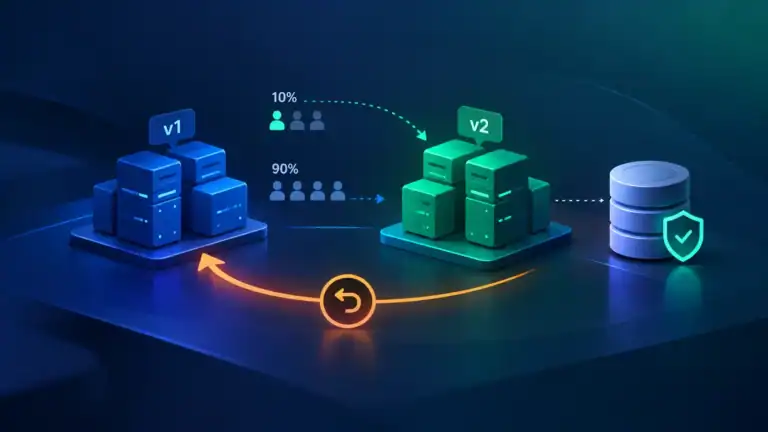
Blue green vs canary deployment decided: zero downtime deployment mechanics, the canary release strategy and its observation ramp,…
Retry with exponential backoff explained: backoff and jitter pacing, the retry storm math, retry budgets, what is safe…
Disaster recovery explained: RTO and RPO as the two numbers that size the plan, the disaster recovery strategies…
High availability explained: the single point of failure hunt, n+1 redundancy sizing, failover design that does not become…
Backpressure explained: the flow-control signal that travels from a slow consumer back to its producers; bounded queues where…