Blue-Green vs Canary Deployment: Shipping Without Downtime
Blue green vs canary deployment decided: zero downtime deployment mechanics, the canary release strategy and its observation ramp, deployment rollback in both worlds, rolling deployment as the third option, and the decision table for which change deserves which.

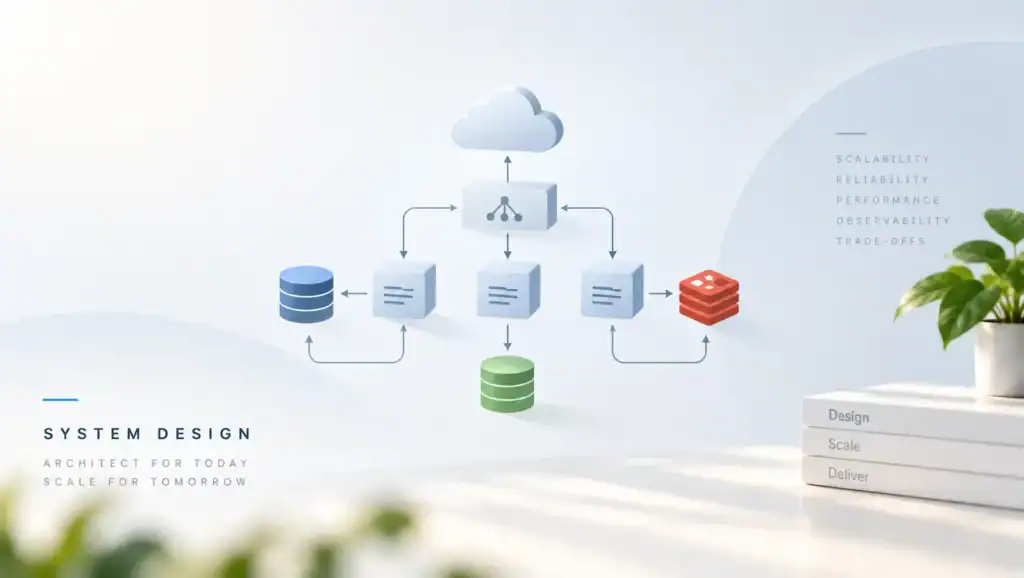
blue green vs canary deployment is the focus of this guide. Blue-green vs canary deployment is the decision between two ways of releasing software without downtime: blue-green switches all traffic between two parallel environments in one move. Canary shifts traffic gradually, proving the new version on a small cohort before it meets the fleet. Both exist to break the same correlation; the bug that reaches every instance in the same instant.
The boundary this page inherits is drawn in its own series: high availability owns the architecture that survives component failures. disaster recovery owns the relight after the scenario-level event; this article owns the third pillar of uptime; the release process itself, the outage source neither architecture can fix once shipping starts. What it does not own: the balancer machinery under any traffic split stays with load balancing and its L4-vs-L7 comparison. The signals that judge a canary belong to the observability series that follows this one.
What are deployment strategies
As a result, deployment earned its own resilience article for one reason: the release is the only fleet-wide, correlated change a system inflicts on itself by design. Hardware failures are roughly independent (that is what makes redundancy work) but a release is a single fault deliberately delivered to every instance in the same moment, which is why it defeats the availability arithmetic: every redundant copy gets the same bug, every standby inherits it, every failover lands on it. “Five bodies, one fault” is the release’s signature, and the outages it causes are the category no amount of n+1 sizing can absorb.
The sizing assumed the failures would not arrive together.
How this plays out in practice
The principle under every zero downtime deployment is the same sentence: never change what the fleet runs in place, everywhere, at once. Keep the new version separable from the old (a parallel environment, a cohort of instances, a batch at a time) so that which version serves is a routing decision instead of a fait accompli. The principle buys two obligations. Backward compatibility: old and new must be able to coexist, because for the duration of the release they do; the API the old version calls, the message the new one emits, the schema both must read.
In contrast, and a traffic control point: the load balancer stops being infrastructure and becomes the release instrument: the hand on the dial that decides, per request, which version the user meets.
The field has three canonical strategies, and this article covers all three because the search question always carries all three names. Blue-green: two parallel environments and an atomic switch: fast, expensive, instantly reversible. Canary: a gradual, evidence-gated rollout where a small cohort proves the version before the fleet adopts it: slower, cheaper, statistical. Rolling: instances replaced in batches: the budget option, with no parallel fleet and no instant undo. They are not rivals so much as tools for different change types. Mature pipelines compose them, which is what the decision table at the end is for.
Blue-green deployment
The mechanics are the strategy’s whole elegance: two environments, one live. Blue serves production; green is the twin, idle or at low traffic. The new version deploys to green. Blue keeps serving (no user ever sees a restart) and green is verified in private: health checks, smoke tests, synthetic traffic, whatever evidence the team trusts. Then the switch: the balancer moves traffic from blue to green, atomically, and the release is over; green is production, blue is the warm standby, and the downtime was zero because nothing the user touches ever changed in place.
The deploy became a routing decision, exactly as the principle asked.
Deployment rollback in a blue-green world is the strategy’s best argument: the old version is not gone, it is warm; flip the balancer back and the fleet is running the last known good release seconds after the decision is made. The honest limit is data. The flip reverses code, not writes: a schema the new version applied, or the poison records it wrote, are still there after the flip-back.
Trade-offs worth weighing
The recovery for those is not a routing change but a migration, which is why blue-green shops ship schema changes separately, on the expand-migrate-contract pattern: add columns the old version ignores, backfill behind both versions, remove the old shape in a much later release. Code is instantly reversible; data changes are planned to never need reversing.
In contrast, the costs are the fine print. Double capacity while the release runs: the price of having a complete second world, which is also why some fleets keep the standby permanently and simply alternate colors every release. Connection drain: in-flight requests and long-lived connections must finish on the old color before it is decommissioned, or the “atomic” flip strands them. And environment drift: the standby that has quietly diverged in config, data, or dependencies is not a standby but a test environment wearing its clothes.
Green must be proven against the same data and the same reality blue serves, or the flip is the moment the drift ships to production. Blue-green is the right tool when verification is confident, the release wants to be fast. The blast-radius question is binary: all traffic on the new version, or all on the old.
Canary deployment
The canary release strategy replaces the atomic flip with a question asked in percentages: let a small cohort meet the new version, watch what happens to them. Let the evidence decide the ramp. The mechanics live in the balancer: route one percent to the canary, the rest to the stable version; weighted splits “operated from the balancer instead of the deploy pipeline,” the exact move L7 load balancing keeps for exactly this purpose.
As a result, the ramp is a staircase (one percent, five, twenty-five, one hundred) and each step is gated on the same question: is the canary cohort behaving like the control, or not?
The analysis is where canaries are won or lost, and it has two rules. Compare like with like: the canary’s error rate and latency are judged against the stable version serving the same traffic in the same window, not against yesterday’s numbers, which changed with yesterday’s traffic. And define the abort before the release: the thresholds that trigger deployment rollback automatically (error rate, latency, saturation, the business metrics that matter) are written when everyone is calm. “is this bad enough?” is a question with a different answer at 2 a.m.
Failure cases to expect
The honest statistical limit: a one percent canary catches the bug that hurts everyone and misses the bug that hurts one percent (for every cohort of users who see it) so the ramp itself is part of the detection: each percentage is a bigger experiment. The last hundred percent is still an experiment, just one the team has earned confidence in.
The costs: duration; a canary release takes as long as its observation windows, so the release train is slower by design; the observability dependency; a canary without trustworthy metrics is a blue-green flip performed blind at every ramp, which is worse than either strategy on purpose; and the fairness question; someone is always the canary. Mature shops choose the cohort deliberately: internal users first, a random slice next, never the customer segment least able to absorb a bad release.
Canary is the right tool when the risk is genuinely unknown, when the blast radius must be tunable rather than binary. When the fleet is large enough that one percent is a meaningful number of real users.
Rolling deployment
The third strategy is the budget option, and it earns its place by being the default rather than the exception. A rolling deployment replaces instances in batches: terminate a few, bring them up on the new version, let the balancer spread traffic across the survivors and the newcomers, verify, repeat until the fleet has turned over. There is no idle twin environment (capacity dips by one batch, not one fleet) and no dedicated release instrument beyond the balancer and the health checks that already exist.
The honest costs: the fleet runs mixed versions for the whole duration of the roll, backward compatibility is not optional for even a minute. The rollback is not a flip but a roll: a fresh, full-speed release of the old version over the top of the failed one, with all the minutes that implies.
Design details that matter
Rolling is the right tool for the routine case: stateless fleets, changes with boring risk profiles. Teams whose verification is cheap and trusted, per-batch health checks doing the gating that a canary’s metrics would otherwise do. Its weakness is the mirror of its economy: the blast radius is only as small as the batch, the mixed-version window is as long as the roll. A bad version still meets real users on batch one. The upgrade path most teams eventually take is rolling with teeth: automated health gates between batches, abort criteria defined in advance.
Batch sizes that start small, which is a canary arriving one rename at a time.
Blue-green vs canary: the decision
The comparison, with rolling in its place, on the axes that actually decide it:
| Dimension | Blue-green | Canary | Rolling |
|---|---|---|---|
| Blast radius | Binary (all traffic flips at once | Tunable) a percentage at a time | One batch at a time |
| Rollback | Instant flip-back to the warm standby | Automated abort to zero percent | Roll the old version back over |
| Speed | Fastest (the switch is atomic | Slowest) observation gates every step | In between (batches gate the pace |
| Extra cost | A second environment during release | Negligible) same fleet, split traffic | None beyond the batch gap |
| Verification style | Confident (pre-flip testing of the twin | Statistical) live evidence from real cohorts | Per-batch health checks |
| Best fit | Low-risk releases needing speed and undo | Unknown-risk changes needing evidence | Routine changes on stateless fleets |
The reading of the table is where the fashion stops and the decision starts. Blue-green buys speed and a perfect undo. Pays for them with a second environment and a blast radius that is still, at the moment of the flip, everything; canary buys evidence and a tunable blast radius. Pays in duration and the observability maturity to judge it; rolling buys economy. Pays in the slowest rollback of the three and a long mixed-version window. The strategies also compose, which is what mature pipelines actually run: canary the new green before the blue-green flip.
Rolling with small first batches and health gates is a canary wearing overalls. The real question is never “which strategy do we use?” but “which guarantees does this change need?” (a risky change wants evidence, a boring change wants speed, a routine change wants economy) and every change knows its own answer if the team writes it down before the release starts.
FAQ
What is the difference between blue-green and canary deployment? Blue-green is binary: two complete environments, an atomic traffic switch, and an instant flip-back. Canary is statistical: the new version receives a small percentage of real traffic, evidence decides each step of the ramp. The abort is an automated return to zero. Blue-green trusts verification done before the flip; canary trusts verification done by production itself. The undo differs accordingly (one routing change versus one automated decision) and so does the cost: a second world versus a split of the one you already run.
Which deployment strategy should my team use? Match the strategy to the change’s risk, not to the team’s fashion sense. Unknown-risk or high-blast-radius changes want canary, because production evidence is the only trustworthy witness. Low-risk changes that need to ship fast and be unshippable just as fast want blue-green. Routine changes on stateless fleets with trusted health checks are what rolling was made for. And compose: canary the green before the flip; start rolling batches small and let the first batch be the canary.
Most mature pipelines run all three, chosen per change by a rule written in daylight.
How does rollback work in blue-green vs canary? Blue-green: the old environment is still warm, so the rollback is the same atomic routing decision as the release, seconds from decision to done. Canary: the rollback is an automated abort, the cohort returned to the stable version the moment the pre-agreed thresholds trip. Both share the honest limit: the undo reverses code, not data. Schema changes and poison writes survive both kinds of rollback, which is why migrations ship separately, on the expand-migrate-contract pattern: additive first, backfill behind both versions, removal much later.
Do blue-green and canary work with database migrations? They work only as well as the compatibility contract the migration ships with. During a canary, a flip, or a roll, old and new code read the same data at the same time. The migration must be additive first: new columns and tables the old version ignores, then the backfill, then the new behavior, then (in a much later release) the removal of the old shape. A migration that breaks the old version is not a migration but an outage scheduled for release day, and no routing strategy survives it.
Is a rolling deployment the same as a canary? Related, not the same. Rolling replaces instances in batches and gates on health checks; canary routes a cohort of users and gates on statistical comparison against the control. A rolling release with small first batches, automated health gates, and abort criteria converges toward canary behavior; the difference is what the gate watches. In practice the convergence is the upgrade path: teams start rolling, add teeth, and end up running canaries without ever having announced the change.
Related articles
- Next read: monitoring and observability, the series that follows this one, and the canary’s judge: the signals, the telemetry, and the difference between watching a fleet and knowing what it is doing.
- fault-tolerant systems, the article that named the enemy: common-mode failure, the correlation between replicas that deployment strategies exist to break before shipping enforces it.
- high availability, the pillar this trio completes: the architecture that keeps the fleet up through component failures, extended at last to the release process that must not take it down.
- disaster recovery, the scenario-level counterpart: when prevention loses anyway, RTO, RPO, and the rehearsed relight back to serving.
- l4 vs l7 load balancing, the machinery under every traffic split: where the balancer looks decides what it can route, and content-aware routing is what makes versions choosable.
- load balancing, the instrument every strategy plays: health checks, algorithms, and the traffic steering that turns releases into routing decisions.
- metrics, the canary’s evidence: golden signals and time series, the numbers the ramp trusts and the abort criteria are written against.
Share this:

Related articles
HTTP/2 vs HTTP/3: Multiplexing, QUIC, and Real-World Performance
HTTP/2 vs HTTP/3 compares streams, head-of-line blocking, and QUIC so you can pick a protocol that stays fast…
Microservice System Design
Executive Summary: Splitting a monolith into services without design discipline trades one problem for distributed complexity. I cover…
Semantic Versioning in Practice: Breaking Changes, Deprecation, and Trust
Semantic Versioning in Practice shows how you mark breaking changes, deprecate old APIs, and keep the trust of…
We do canaries for risky schema-adjacent deploys and blue-green for everything else. The decision table matches that pretty well.