Build Caching Explained: Speeding Up CI Without Breaking Reproducibility
Build Caching Explained shows how to speed up CI and still ship the same bits. Learn cache keys,…
Category
These system design guides cover how to build software that scales and stays up. There are over a hundred posts, grouped by topic.
For a start, read load balancing and caching. Then high availability covers uptime. Also, each sub section goes deeper into one area.
112 articles
Build Caching Explained shows how to speed up CI and still ship the same bits. Learn cache keys,…
DNS for Backend Engineers shows how name lookups, caches, and TTL choices fail in production, and how you…
What an API gateway does (routing, authentication, rate limits, transformation) how it differs from a reverse proxy and…
Docker for Backend Systems covers images, layers, networks, and hardening. Learn what fails in production, how to cut…
How a CDN serves content from edge servers near users; cache hits, origin fetches, TTLs, cache hit ratio,…
CI/CD for Backend Engineers explains pipelines, artifacts, and safe deploys. See what breaks in production, how to scale…
What a reverse proxy is, what it does (TLS termination, routing, security) how it differs from a forward…
What a load balancer does, how L4 and L7 balancing differ, which algorithm to pick (round robin, least…
TCP vs UDP explains when you want reliable streams, when datagrams win, and how loss, latency, and head-of-line…
Client server architecture explained: how the client server model works, stateless vs stateful servers, and the request response…
CAP says that during a network partition, a distributed system must choose between consistency and availability. Precise definitions,…
Availability is uptime, reliability is correct behavior over time, durability is data survival. Exact definitions, the nines table,…
Latency is the time one request takes; throughput is how many requests you serve. How they differ, why…
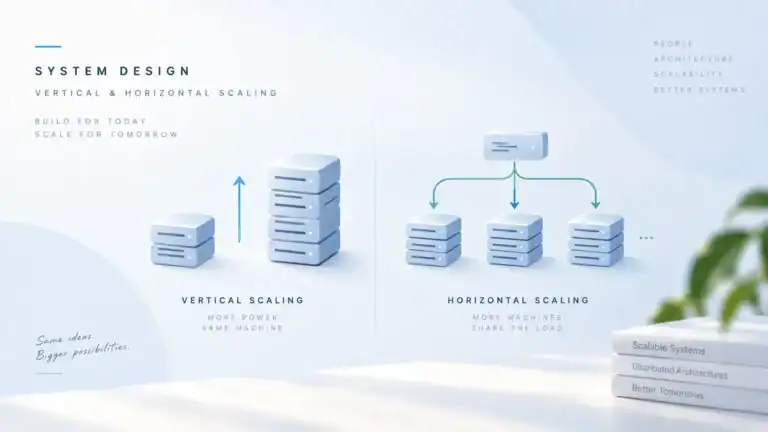
Scaling a system isn’t always as simple as adding more resources. As your application grows, the way you…