By Imran M ·
· 4 min read
By Imran M ·
· 4 min read
Jev AI Model: The Fastest Adopted Model in AI Gateway History
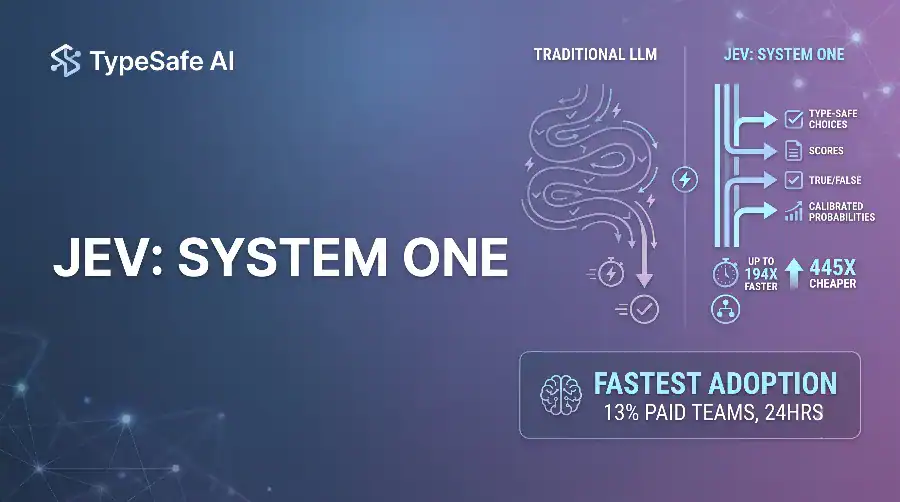
In just 24 hours, TypeSafe AI’s new decision model, Jev, achieved something unprecedented: it reached nearly 13% of paid teams on AI Gateway. To put that in perspective, that is more than twice the adoption of the GPT-5.6 family and over six times that of Fable 5.1.
While the numbers are striking, the real story is the massive category shift it represents in artificial intelligence.
The Problem with Current Language Models
Most model launches today are just variations on a familiar theme: general-purpose language models that generate content. They create text, summarize articles, reason in prose, and return paragraphs. When GPT first launched, the breakthrough was the “text in, text out” interface. Suddenly, language became programmable.
The industry was flooded with faster, cheaper, and longer-context models. But they all shared the same foundational primitive: they produce text.
For all its flexibility, free-form text is a fragile thing to put inside a production software workflow.
- A workflow doesn’t need an essay; it needs a concrete decision.
- A guardrail doesn’t need fluent prose; it needs a typed answer it can route.
- An autonomous agent doesn’t need a paragraph of reasoning; it needs to know exactly which tool to call next.
Production systems aren’t ambiguous. They are strict contracts: If this, then that. Continue or stop. Retry or escalate. The gap between a model that writes and a model that decides is the difference between a cool demo and a reliable software dependency.
Enter Jev: A Probabilistic Decision Model
Jev is fundamentally different from the daily barrage of text-generating LLMs. Introduced by TypeSafe AI on September 15, Jev is a probabilistic decision model built explicitly for structured decision-making inside applications.
Inspired by Daniel Kahneman’s concept of fast, intuitive “System 1” thinking, Jev acts as a frontier-intelligence function call. You send Jev unstructured context and a set of questions, and it evaluates those questions in parallel. Instead of strings of text, it returns:
- Typed choices
- Scores
- True-or-false answers
- Epistemically honest, calibrated probabilities
This distinction isn’t just marketing; it’s a massive architectural shift. Because Jev is mathematically constrained to predefined schemas, it cannot hallucinate type errors. Developers finally get answers in the exact shape their applications already understand, eliminating the need for brittle parsing, validation layers, and retry loops.
Why Jev is Breaking Records
How did Jev become the fastest-adopted model in AI Gateway history, crossing a tenth of teams in just 18 hours when every other recent model stayed below 7%? It comes down to its revolutionary underlying tech stack:
1. Parallel Sampling vs. Sequential Generation
Traditional LLMs generate text autoregressively (one token at a time). Jev uses a parallel sampler, generating all outputs in a single query. This makes it incredibly efficient and hardware-aware.
2. RLCD Training
While traditional models use RLHF (Reinforcement Learning from Human Feedback) to sound more pleasing to humans, Jev is trained using a new method called RLCD (Reinforcement Learning for Calibrated Decisions). It optimizes for epistemically honest probabilities on high-stakes tasks.
3. Mind-Blowing Speed and Cost Efficiency
In TypeSafe AI’s workflow evaluations, Jev completely changed the math for AI in production:
- Speed: End-to-end response times range from just 70ms to 500ms (up to 194x faster than language models). This enables real-time AI applications that UX previously wouldn’t allow (TypeSafe even showcased Jev powering real-time Doom bots!).
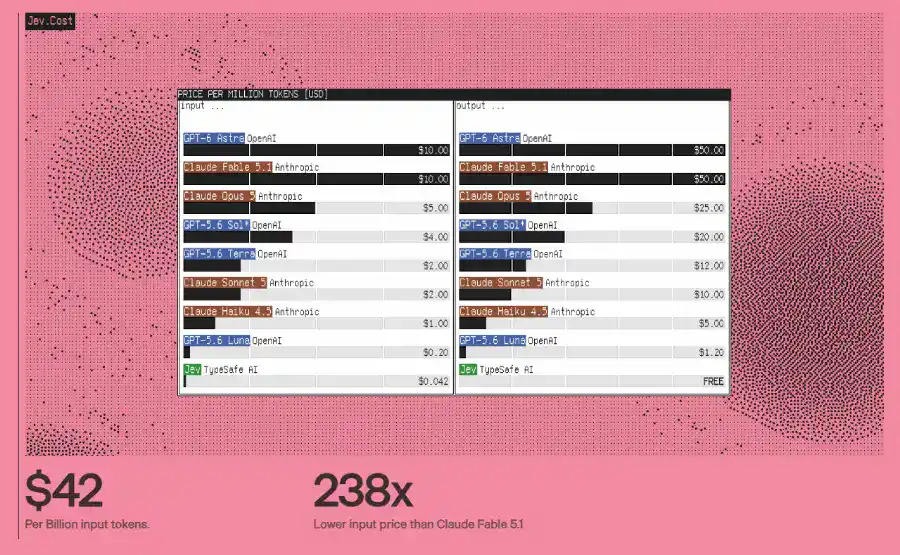
- Cost: Jev is up to 238x cheaper than Fable 5.1. Input tokens cost a mere $0.042 per million, and output tokens are entirely FREE.

What the Jev AI Model Actually Solves
Modern applications are full of small, high-stakes decisions. Which tool should the agent call? Is this output safe? Is this case urgent? Should a human review it?
Language models approximate these decisions by generating text, forcing developers to write complex “glue code” to parse the results. Jev returns operational decisions directly. It can:
- Choose an agent’s next sub-agent or tool.
- Decide whether a workflow should continue, stop, or ask the user.
- Score urgency or risk before an action is taken.
- Verify model outputs and enforce guardrails at lightning speed.
The next test and most important one – the bottom line.
First-day adoption is a signal, not a verdict. The next question is whether the Jev AI model becomes a permanent part of the modern developer stack. But this early adoption curve is impossible to ignore. When a specialized model finds this kind of immediate market pull, it means development teams were previously solving this problem manually, badly or very expensively.
Jev didn’t win by being another model that writes beautifully. It won by being a model that decides reliably. In the software world, operational reliability always wins, and that is exactly the kind of breakthrough that turns into quick and permanent adoption.
Want more insights on the latest AI development trends? Bookmark imraan.in for the latest updates on software architecture and AI tools.
Here is a funny take on LLM vs Jev.
Share this:

Related articles
MCP Explained: Model Context Protocol Guide
If you have written code that calls an LLM API, you know the drill: define tools, parse the…
AI Agent Harnesses, Explained
Whether you’ve never gone beyond a chat window or you’re already shipping agents to production, this is a…
5 AI Models for Image Generation Dominating the Enterprise Stack
Visual content creation has completely transformed over the last few years. We have moved far beyond the days…