 By Imran M ·
· 10 min read
By Imran M ·
· 10 min read
Vertical vs Horizontal Scaling: Choosing How to Grow
Scaling a system isn’t always as simple as adding more resources. As your application grows, the way you scale can have a major impact on performance, cost, and complexity.
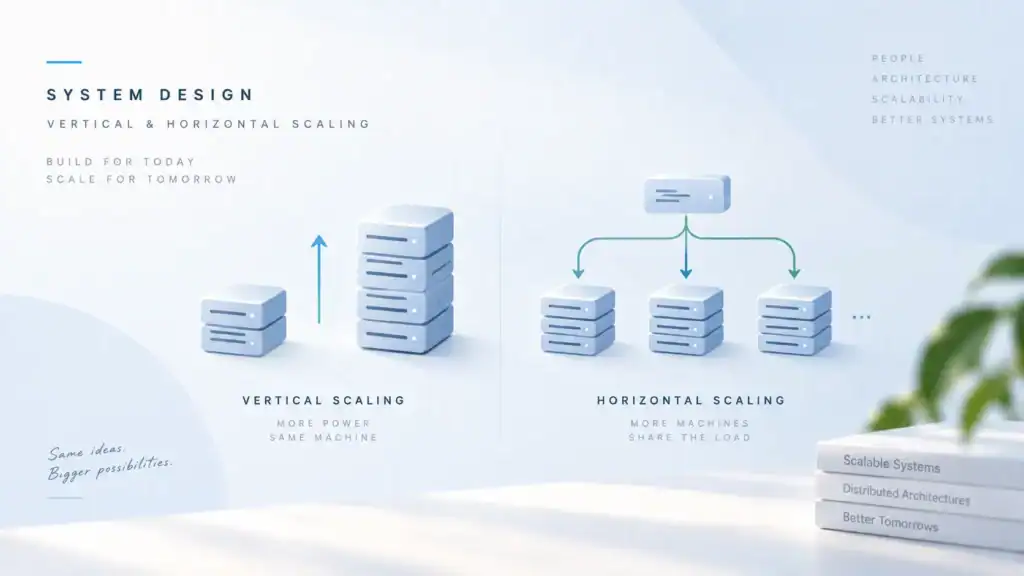
A checkout service that comfortably handles 500 requests per second on one server will not handle 5,000 requests per second on that same server. Something has to change: the machine, or the number of machines. That decision — scale up or scale out — is the first structural fork in nearly every growing system, and it determines the cost curve, the fault tolerance story, and how much distributed-systems complexity the team inherits.
Vertical vs horizontal scaling is the distinction between the two options. Vertical scaling (scale up) increases the capacity of a single machine: more CPU cores, more memory, faster storage. Horizontal scaling (scale out) adds machines and spreads the work across them. Vertical scaling makes each node bigger; horizontal scaling makes the fleet bigger.
This article is part of the System Design fundamentals set that the rest of this library builds on.
What scalability means
Scalability is the ability of a system to absorb more load by adding resources, without a redesign. Load arrives in three main currencies: requests per second, data volume, and concurrent users. Adding resources can mean adding capacity to one machine (vertical) or machines to a fleet (horizontal).
Scalability is not the same as performance tuning. Making a single request faster — better algorithms, indexes, query plans — is optimization. Scaling is about what happens when more work arrives than the current design can absorb. The two interact: the cheaper each request is, the more requests one machine serves, and the later you pay the scale-out tax. The cost of a single request is measured with latency and throughput, covered in latency vs throughput.
Two practical notes before comparing the strategies:
- Growth is a multiple, not a slope. Growing from 1,000 to 2,000 users is a different problem from growing from 1,000 to 2,000,000. The first is usually solved with tuning; the second forces architecture.
- Scaling down matters as much as scaling up. A fleet sized for peak traffic that cannot shrink costs money all night. Elasticity — adding and removing capacity automatically — is a first-class requirement in cloud environments, and it is dramatically easier horizontally.
Vertical scaling: making the machine bigger
How it works
Nothing about the software changes. The database that ran on 8 cores and 32 GB of RAM is moved to 64 cores and 512 GB. The instance class goes up; the deployment stays at one node. Cloud platforms sell this directly: pick a larger instance type, restart into it.
Vertical scaling also includes the less glamorous moves — more memory so more of the working set fits, faster NVMe storage so fewer queries wait on I/O, more connections allowed by a bigger kernel. It is often the highest-leverage first response to a capacity problem.
Where vertical scaling wins
- It requires no architectural change. Single-node software remains single-node. Transactions stay local, locks stay in one process, and nothing new can fail because nothing new was added.
- It keeps strong consistency cheap. A single node has one copy of the truth. You postpone every problem of database replication, cache coherence, and distributed coordination.
- It is fast to execute. Resizing a machine is measured in hours; re-architecting to a distributed fleet is measured in months.
- Databases are historically its best customer. For years, the practical scaling path for relational databases was up, not out — and even heavily sharded systems usually keep each shard as a large single node.
The ceilings
Vertical scaling hits walls that no vendor can move:
- Hardware ceilings. There is a largest machine you can rent. Beyond that point, “scale up” simply has no product left to sell you.
- A superlinear price curve. The machine with twice the cores costs substantially more than twice as much, and the machine with four times the cores costs substantially more than four times as much. Flagship hardware is priced disproportionately because the market for it is thin and the engineering is exotic. The last doubling is always the worst value.
- One machine, one failure domain. Every host failure is a full outage, and the replacement time — detection, provisioning, restore, restart — is your downtime. Availability targets are covered in availability vs reliability vs durability.
- Upgrades are usually restarts. Growing the machine classically requires taking it down. Managed platforms reduce this with live migration, but the operation remains a maintenance-window event.
- It never improves fault tolerance. A bigger machine fails exactly like a small one: totally. Redundancy, failover, and N+1 designs are horizontal concepts — the subject of fault-tolerant systems.
Horizontal scaling: making the fleet bigger
How it works
Instead of one powerful machine, run the service on many commodity machines and place a load balancer in front of them. The load balancer distributes requests using an algorithm — round robin, least connections, consistent hashing — and stops sending traffic to nodes that fail health checks. Each added machine raises total capacity roughly linearly; each removed machine lowers it. If one node dies, the others absorb its share while it is replaced.
The same idea applies to data: database replication adds copies of the same data across machines, and database sharding splits one logical dataset across many machines. The comparison between the two is its own decision — see sharding vs replication.
The requirements it imposes
Horizontal scaling is cheap in hardware and expensive in design. Scaling out a service without breaking it requires:
- Statelessness. Any request must be servable by any node. Session state, file uploads held in local memory, and background jobs pinned to one process all break this. State has to move out of the app tier — into a database, a distributed cache, or object storage.
- Distribution-aware data access. Once data lives on many nodes, something must decide which node holds which request’s data. That is the job of techniques like consistent hashing.
- Coordination machinery. With many nodes come distributed concerns: who leads when nodes disagree (leader election), how replicas agree on one value (distributed consensus), and how updates propagate across the fleet. These are the curriculum of distributed systems — the price of horizontal scale is that your team now owns that curriculum.
- Operational surface area. Ten machines means ten things to deploy, patch, monitor, and debug — with failures that only reproduce under concurrency and partial outage. A circuit breaker stops one slow dependency from dragging the whole fleet down; an API gateway centralizes cross-cutting concerns.
Where horizontal scaling wins
- Near-linear cost. Doubling capacity costs roughly double. Commodity machines sit at the cheapest point of the price-performance curve, and autoscaling groups convert idle nights back into savings.
- Fault tolerance as a side effect. The fleet survives node loss by design. Redundancy is the mechanism behind every serious availability target — see availability vs reliability vs durability.
- No ceiling in practice. You run out of budget long before you run out of machines. The internet’s largest services scale out precisely because no single machine exists that could do the job.
- Zero-downtime operations. Rolling deployments, blue-green releases, and live capacity changes all require multiple nodes — they are impossible vertically.
The comparison in one table
| Dimension | Vertical (scale up) | Horizontal (scale out) |
|---|---|---|
| Unit of growth | Bigger machine | More machines |
| Cost curve | Superlinear near the top | Roughly linear |
| Ceiling | Largest available hardware | Practically none |
| Fault tolerance | None — one failure domain | Redundant by construction |
| Availability ceiling | Bounded by single machine’s MTTR | Bounded by design quality |
| Consistency | Trivial (one copy) | Requires replication strategy |
| Code change required | None | Statelessness, distribution logic |
| Operational complexity | Low | High — fleet-wide concerns |
| Upgrade path | Maintenance window, restart | Rolling, zero-downtime |
| Best for | Databases, stateful single-node systems | Stateless services, caches, web tiers |
How real systems combine the two
In practice the choice is not either/or. The standard growth path of a web system:
1 application server + 1 database
        ↓  traffic grows
Scale up: bigger app server, bigger database, add indexes, tune queries
        ↓  single machine saturates
Scale out the app tier: N stateless servers behind a load balancer
        ↓  database saturates
Scale the data tier: read replicas first, then sharding
        ↓  latency under load grows
Add caching layers: application cache, then distributed cache, then CDN
Notice the pattern: the stateless tier scales out early and aggressively, while the stateful tier scales up first and scales out later, reluctantly, because data distribution is where the hardest problems live. Even hyperscale systems keep individual machines large — a sharded fleet is usually a collection of big single-node databases with a routing layer on top.
Choosing: a decision framework
Answer these questions in order:
- Is the workload stateless? If yes, scale out when you need fault tolerance or growth beyond one machine. If no, scale up first — distributing state is a project, not an upgrade.
- What is the growth multiple? Planning for 2× next year is a tuning problem. Planning for 50× is an architecture problem that requires horizontal design from the start — retrofitting statelessness later is far more expensive.
- Is there an availability target? If the system needs more availability than one machine can deliver — and remember that every upgrade and repair of a single node is downtime — horizontal redundancy is mandatory. The math is in availability vs reliability vs durability.
- Is the bottleneck CPU, memory, or I/O? A memory-bound process that saturates a 32-core machine may scale up beautifully. A stateless HTTP tier should not have been on one machine to begin with.
- Can the team operate a distributed fleet? Horizontal scale imports distributed-systems failure modes — partial failure, clock skew, network partitions. A team that cannot debug those yet is often better served scaling up a while longer.
Rule of thumb: scale up until it hurts — an availability requirement or the hardware ceiling — then scale out. And design for scale-out before either one arrives.
When NOT to scale horizontally
Horizontal scaling has a hidden price tag: coordination. The moment work and data spread across machines, the system inherits every distributed-systems problem — consistency, partial failure, deployment ordering, correlated outages. That cost is real even when machines are cheap. Three situations argue for staying vertical:
- The system fits comfortably on one big machine. Many internal tools, dashboards, and mid-size applications never need more. Adding a load balancer and three nodes to a system that fits on one is not architecture; it is complexity bought without a need.
- Strong single-copy semantics are the product. Some systems — a serialization-sensitive workflow engine, a queue with strict ordering guarantees — are dramatically simpler on one node. Distribution to gain capacity you do not need buys complexity that outruns the benefit.
- The team cannot yet operate the distributed version. A distributed system run badly is less available than a single server run well.
The same discipline applies to service decomposition: microservices architecture is horizontal scaling applied at the organizational level, and it fails for the same reason when adopted without need.
Common mistakes
- Scaling out stateful code. The load balancer spreads requests; the in-memory session cache does not come along. Result: random logouts and lost carts until state moves to a shared store such as a distributed cache.
- Adding servers without a distribution strategy. Round robin over ten stateful session servers is not scaling; it is ten independent systems behind one IP.
- Sharding before replication. Replication solves read scale and failover cheaply; sharding solves write scale expensively. Teams that shard first often discover they needed read replicas all along.
- Forgetting the failure domain. Ten nodes in one rack, on one power circuit, or in one availability zone is still one failure domain. Horizontal scale only delivers availability when the redundant capacity is actually redundant.
- Never scaling down. A fleet at 3 a.m. sized like the fleet at 3 p.m. burns budget for nothing. Elasticity is half the value of scale-out.
FAQ
Is horizontal scaling always better than vertical scaling?
No. Vertical scaling is the fastest, simplest response to capacity pressure, and it keeps single-node consistency. It is the right default for stateful components like databases until an availability requirement or the hardware ceiling forces distribution. Horizontal scaling wins for growth, elasticity, and fault tolerance — at the cost of distributed-systems complexity.
Can a database scale horizontally?
Yes, through replication (copies of the same data) or sharding (data split across machines). Replication scales reads and improves failover; sharding scales writes. Both introduce consistency and operational trade-offs covered in sharding vs replication.
What is the difference between scale up and scale out?
They are synonyms for the two strategies: scale up means vertical scaling (a bigger machine), scale out means horizontal scaling (more machines). Cloud documentation also uses “scale in” for removing machines.
Does vertical scaling improve availability?
No. A bigger machine fails the same way a smaller one does — completely. Only horizontal designs (redundancy plus failover) raise availability; the definitions and targets are in availability vs reliability vs durability.
When should scaling be automatic?
When load is variable and unpredictable — web tiers, APIs, batch workers. Autoscaling needs a stateless tier, health-checked nodes, and fast machine provisioning. Steady-state systems with predictable load gain little from it.
Share this:

Related articles
Microservice System Design
Executive Summary: Splitting a monolith into services without design discipline trades one problem for distributed complexity. This post…
CAP Theorem in Distributed Systems
Distributed systems are the backbone of modern technology, enabling everything from social media platforms to financial services. Yet,…

